Introducing Asurvo: An AI-Powered GRC Platform for Modern Security Teams
Asurvo is an AI-powered GRC platform that unifies governance, risk, compliance, audit, vendor risk and trust in one workspace. Here's why we built it.
Every GRC tool we evaluated made the same tradeoff: heavy automation with shallow governance, or deep governance with a 1998 interface. We built Asurvo because we didn't want to make that tradeoff.
Asurvo is an AI-powered GRC platform that brings governance, risk management, compliance, audit, third-party risk and trust into one workspace. It helps teams generate control sets, draft policies, surface risks, collect evidence and cross-map controls across frameworks, so the work of running a security program happens in one system instead of across a dozen spreadsheets and shared drives.
Our goal is simple to state: visibility in hours, assurance in days, certified in weeks. This article explains why we think that's achievable, what Asurvo does, and how we approach GRC differently.
Why we built Asurvo
Ask anyone who runs a governance, risk and compliance program how the work actually gets done, and you'll hear a familiar story. Policies live in one folder. The risk register is a spreadsheet with a dozen tabs and three people who each think they own it. Controls are tracked somewhere else, evidence is scattered across screenshots and exports, and vendor questionnaires sit in an inbox.
None of this is anyone's fault. Most GRC programs grow one requirement at a time. A customer asks for SOC 2, so a SOC 2 project starts. A year later, an enterprise deal needs ISO 27001, so a second project starts. Then a healthcare prospect asks about HIPAA. Each framework arrives with its own control list, its own evidence requests and its own spreadsheet.
The result is a set of predictable problems:
- Duplicated work. The same access review gets collected three times for three frameworks.
- Disconnected risk and controls. Risks are assessed in one place and controls are managed in another, so nobody can say with confidence which controls actually reduce which risks.
- Manual evidence collection. Hours go into chasing owners, renaming files and checking dates.
- Last-minute audit preparation. Readiness becomes a sprint in the weeks before fieldwork instead of a normal state.
- Low visibility. Leadership asks "are we compliant?" and the honest answer is "let me check."
We wanted a platform that treats these as one connected problem, not six separate ones.
What is Asurvo?
Asurvo is GRC software built around a single idea: your controls, policies, risks, evidence, audits and vendors are related, so they should live in the same place and be connected to each other.
For a security engineer, that means a control can be connected to its owner, its evidence, the risks it addresses and the framework requirements it maps to. For a business leader, it means a clear view of where the organization stands against each framework, which risks are open and what an auditor will ask for next.
The "AI-powered" part is practical. Asurvo uses AI to handle the work that is slow to do from scratch: generating a starting control set, drafting policies, surfacing risks and helping map controls across frameworks. People stay in charge of decisions. AI gets you to a reviewed first draft faster, so your team spends its time on judgment rather than formatting.
The six core areas of Asurvo
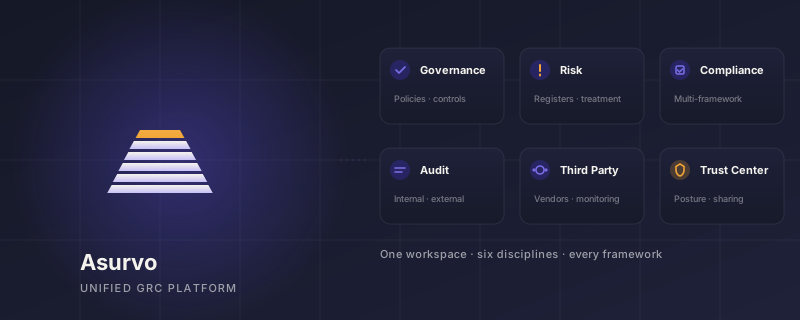
Asurvo is a single workspace for the six core disciplines of any GRC program. Each is useful on its own. The value compounds when they share the same data.
Governance
Governance is the foundation: the policies that describe how you operate, the controls that put those policies into practice, and the evidence that shows the controls work. In Asurvo, policies and controls can be assigned owners, and evidence is kept alongside the controls it supports. When an auditor asks who owns access reviews and when the last one happened, the answer should be easy to find.
Risk Management
A risk register is only useful if it changes decisions. Asurvo is designed around the full cycle: identifying risks, assessing them, deciding how to treat them, assigning ownership and monitoring them over time. Keeping risks in the same workspace as controls makes it easier to see which controls matter most and where a weak control increases exposure.
Compliance
Compliance management in Asurvo starts from frameworks, including ISO 27001, SOC 2, NIST CSF, HIPAA, PCI DSS, GDPR, NIST 800-53, CIS Controls and custom frameworks. You can browse the full list of supported frameworks. Framework requirements are mapped to your controls, and gap analysis helps show where requirements are covered and where work remains.
Audit
Internal and external audits follow the same pattern: define scope, request evidence, review it, record findings and track remediation. Asurvo supports internal and external audit workflows using the controls and evidence already in the platform, so an audit draws on existing work rather than starting a fresh collection exercise. Keeping findings close to the controls they concern makes remediation easier to follow.
Third Party Risk
Your security posture includes the vendors you rely on. Asurvo brings vendor inventory, assessments and continuous monitoring into the same workspace as the rest of your program, so third-party risk management sits next to your internal risks rather than in a separate tracker.
Trust Center
Customers and prospects want to know how you protect their data before they sign. A Trust Center gives you one place to share your security and compliance posture with customers and prospects. It can help shorten security reviews and spare your team the NDA dance on every deal.
Why modern GRC needs more than automation
GRC automation is valuable. Pulling evidence automatically, sending reminders and tracking status without manual updates removes a lot of tedious work. But automation on its own answers a narrow question: did this thing happen?
A mature program needs to answer harder questions:
- Governance: Is this the right control, is it documented, and who is accountable for it?
- Risk context: Which risk does this control reduce, and what happens if it fails?
- Evidence: Is the proof current, complete and tied to the right requirement?
- Continuous visibility: What is our posture today, not at the end of last quarter?
Automation without governance produces green checkmarks nobody can explain. Governance without automation produces well-written policies that drift out of date. Modern GRC needs automation, governance, risk context, evidence and accountability working together. Asurvo is what a modern team would build given a blank slate: automation where it matters, with the governance rigor of the old guard.
One control, multiple frameworks
Most frameworks describe overlapping security practices in different language. Cross-framework compliance takes advantage of that overlap.
Take access control. Reviewing user access on a regular schedule, removing access when people leave and restricting privileged accounts are practices that show up in some form across SOC 2, ISO 27001, NIST CSF, HIPAA and PCI DSS. Running five separate access review programs makes no sense. A better approach is to operate one well-designed control, collect evidence for it once, and map it to each applicable requirement.
| Example · one control, several mappings | Quarterly user access review |
|---|---|
| Lives on the control | Owner, review cadence and evidence |
| Mapped to | The relevant access control requirements in SOC 2, ISO 27001 and NIST CSF, where the underlying scope, intent and requirements align |
That last condition matters. One control does not automatically satisfy every requirement that sounds similar. Frameworks differ in scope, frequency, depth and wording, and an auditor will test against the specific requirement in front of them. Good mapping is deliberate: a control maps to a requirement where the underlying scope, intent and requirements align, and gaps are flagged where they don't.
In Asurvo's compliance workspace, controls are the unit of work and frameworks are views on top of them. A control you add for SOC 2 can count toward ISO 27001 and NIST CSF the moment you save it, where the mapping applies. Adding a new framework becomes a gap analysis against what you already run, not a new program.
From manual compliance to continuous compliance
There is a difference between preparing for an audit and running a compliance program.
Audit preparation is episodic. A date gets set, a checklist comes out, and the team spends weeks gathering screenshots, updating policies that haven't been touched in a year and closing gaps that have been open for months. After the audit, attention moves elsewhere until the cycle starts again.
Continuous compliance treats the same work as ongoing operations:
- Evidence collection happens on the control's schedule, not the auditor's.
- Control monitoring shows when a control is overdue or failing, while there is still time to fix it.
- Risk updates follow real changes in the business, such as a new product, vendor or market.
- Policy reviews run on a cadence with owners and reminders.
- Audit readiness becomes a status you can check at any time.
If you're still working from spreadsheets, a structured audit evidence tracker is a good first step toward this model. Asurvo takes it further by connecting evidence to controls, risks and frameworks, so the state of your program is easier to see at any point instead of being reconstructed before each audit.
What makes Asurvo different?
We made a few opinionated choices early, and they shape the whole product.
- AI-assisted, human-owned. AI generates control sets, drafts policies and surfaces risks. Your team reviews, edits and approves. Accountability stays with people.
- One workspace. Governance, risk, compliance, audit, vendors and trust live in one place, so there are fewer separate tools to reconcile.
- Evidence reused where it applies. Evidence sits with controls, and controls map to requirements, which reduces duplicate collection.
- Cross-framework by default. Frameworks are mapped onto a shared control set, which should make the second and third framework less work than the first.
- Risk in the same picture. Risks and controls sit in the same workspace, so control health and risk exposure can be reviewed together.
- Built for the people doing the work. Clear ownership, sensible defaults and workflows that match how security and compliance teams already operate.
You can read more about why we built Asurvo this way.
Who is Asurvo for?
Asurvo is built for organizations that treat security and compliance as an ongoing responsibility. That typically includes:
- SaaS companies whose customers ask for security assurances during sales.
- Security, compliance and GRC teams that want one system instead of a stack of spreadsheets.
- Organizations preparing for ISO 27001 certification or a SOC 2 report for the first time.
- Companies managing several frameworks that want to stop duplicating controls and evidence.
- Leadership teams that need clear visibility into risks, controls and evidence.
If you have a single framework, a small scope and a process that already works well, you may not need a dedicated GRC platform yet. Asurvo earns its place as scope, frameworks and stakeholders grow.
What we're building next
This is the first of many posts. Over the coming months we'll share practical deep dives on how we approach control libraries, evidence reuse, audit workflows, risk management, compliance automation, cross-framework compliance and continuous compliance.
These posts are meant to be useful whether or not you use Asurvo. In the meantime, our free GRC templates are a practical starting point. If there's a topic you'd like us to cover, we want to hear it.
Final takeaway
GRC should not be a collection of disconnected spreadsheets, tools and last-minute audit exercises. It should be an operating system for how an organization manages governance, risk, compliance and trust.
That is what we're building with Asurvo: one AI-powered GRC platform where controls, risks, evidence, audits and vendors stay connected, and where readiness is the normal state.