Native or nothing — why we built 100+ integrations the hard way
Middleware-based integrations look the same on a comparison chart. They aren't. Here's why every Asurvo connector is native, and what that buys you at audit time.
When a buyer asks "does it integrate with our stack?", every GRC vendor says yes. The honest answer is almost always "it depends what you mean by integrate." There's a real difference between a native connector, a middleware bridge, and a CSV upload disguised as one — and that difference shows up later, on the day your auditor asks for evidence.
Three shapes of "integration"
In a vendor demo, all three of these get the same green checkmark on a feature grid. They behave very differently in production.
- Native API integration. Asurvo authenticates directly to the source system, polls or subscribes to changes, and stores evidence with its source-of-truth metadata intact. When something changes upstream, your control evidence updates. When the source system goes down, you know.
- Middleware integration. A third-party connector platform (Workato, Zapier, MuleSoft, a homegrown ETL) sits between the source system and the GRC tool. You're now maintaining two integrations: one to the middleware, one through it. Failure modes multiply. Latency goes up. Cost goes up. Vendor lock-in goes up.
- CSV upload "integration". A scheduled export from the source system gets dropped into a watched folder. This is a file transfer with extra steps. There is no API. There is no real-time signal. There is, however, a checkbox on a comparison chart.
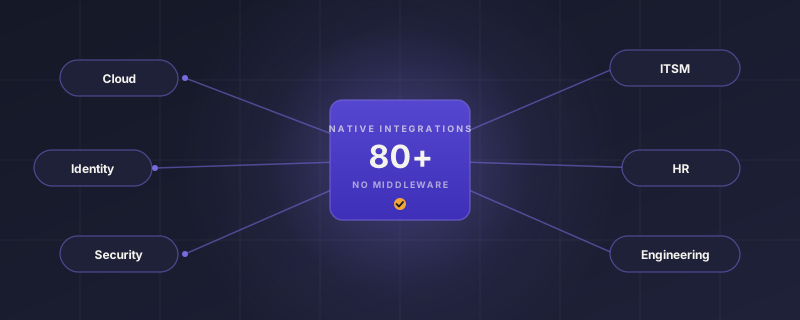
We built every Asurvo connector as native API integration. No middleware. No CSV uploads. No glue scripts. There are 100+ of them across cloud, identity, security, vulnerability management, ITSM, HR, AI, and engineering tooling, and every single one talks directly to the source system.
Why this matters when the auditor shows up
Three things change when your integrations are native.
Evidence is fresh. A native integration knows when something changed five minutes ago. A CSV-based one knows what was true at last week's export. When an auditor asks "show me current MFA enrollment for production admins," you want the first answer, not the second.
Evidence is attributable. A native integration records which user in which system did which thing at which time. A middleware pipe often strips that metadata. When you're trying to prove a control like "privileged access reviews are performed quarterly by the system owner," you need attribution all the way down.
Evidence is reactive. When a control breaks — a user gets over-privileged, a critical patch goes missing, an MFA enrollment lapses — a native integration can flag it the same day. Without that, your control monitoring is a quarterly photograph of a continuously changing system.
Where the work actually went
Native integrations are more work than middleware integrations. That's the trade. Every cloud provider has its own auth model, its own rate limits, its own pagination, its own quirks around how evidence is exposed. Identity providers don't agree on what a "group" is. Security tools don't agree on what a "finding" looks like. We wrote real adapters for every one.
The boring part of that work — the part that doesn't show up in a demo — is what makes the difference at audit time. It's why the integration count on our page isn't just a number we're proud of; it's a number we're willing to back up by name. See the full catalog on the integrations page.